
PersonaShot
Benchmarking Person-Centric Narrative Continuity in Multi-Shot Video Generation
1Shanghai Jiao Tong University · 2Tencent Youtu Lab · 3Zhejiang University (∗ equal contribution, † corresponding)
Benchmarking Person-Centric Narrative Continuity in Multi-Shot Video Generation
1Shanghai Jiao Tong University · 2Tencent Youtu Lab · 3Zhejiang University (∗ equal contribution, † corresponding)
Video generation is rapidly evolving from single-shot clips to multi-shot narratives, where the human character serves as the core narrative anchor. However, existing benchmarks mainly assess character appearance or individual-shot quality, without measuring whether physical and emotional states remain coherent across cuts.
We introduce PersonaShot, the first person-centric benchmark for narrative continuity in multi-shot video generation. PersonaShot contains approximately 1,000 multi-shot segments and 16 metrics spanning physical continuity, affective dynamics, and cinematic grammar. We distill reasoning from a large multimodal teacher (Qwen3.5-397B) into lightweight specialist evaluators (Qwen3.5-4B + LoRA), each grounded in the evidence required by its metric, and align them with expert human judgments.
Our evaluation reveals distinct capability profiles across state-of-the-art models and a clear gap between perceptual quality and cross-shot narrative continuity.
Spatial Layout, Object State Persistence, Geometric Scale — do character positions, held objects, and proportions remain causally consistent across editing cuts?
Expression Naturalness, Facial-Action Temporal Coherence, Emotion-Narrative Alignment, Emotional Arc — do affective states evolve coherently without abrupt resets?
Shot Transition, Transition Rhythm, 180° Rule, Eyeline Match, Directorial Narrative Sequencing — does the sequence follow film-language conventions?
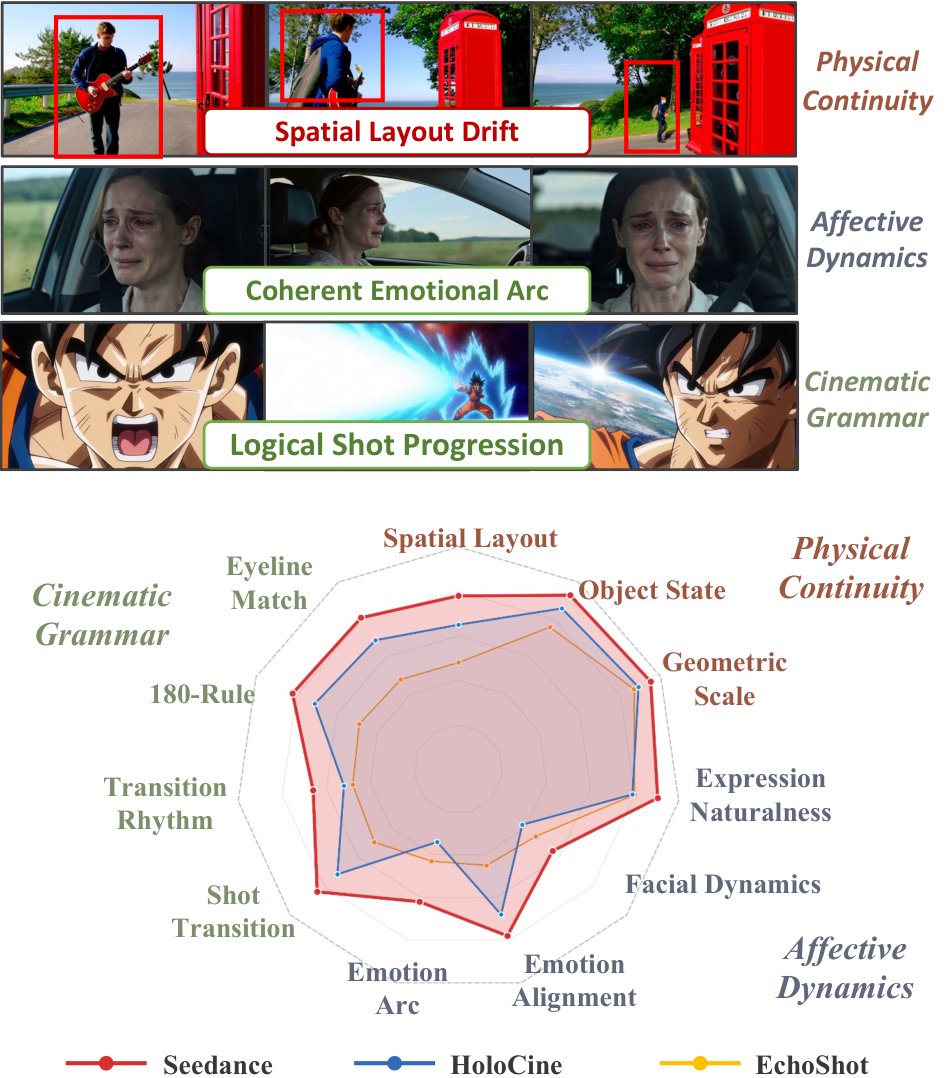
Top: Qualitative examples illustrating three core dimensions. Bottom: Quantitative comparison revealing distinct capability profiles of state-of-the-art models.
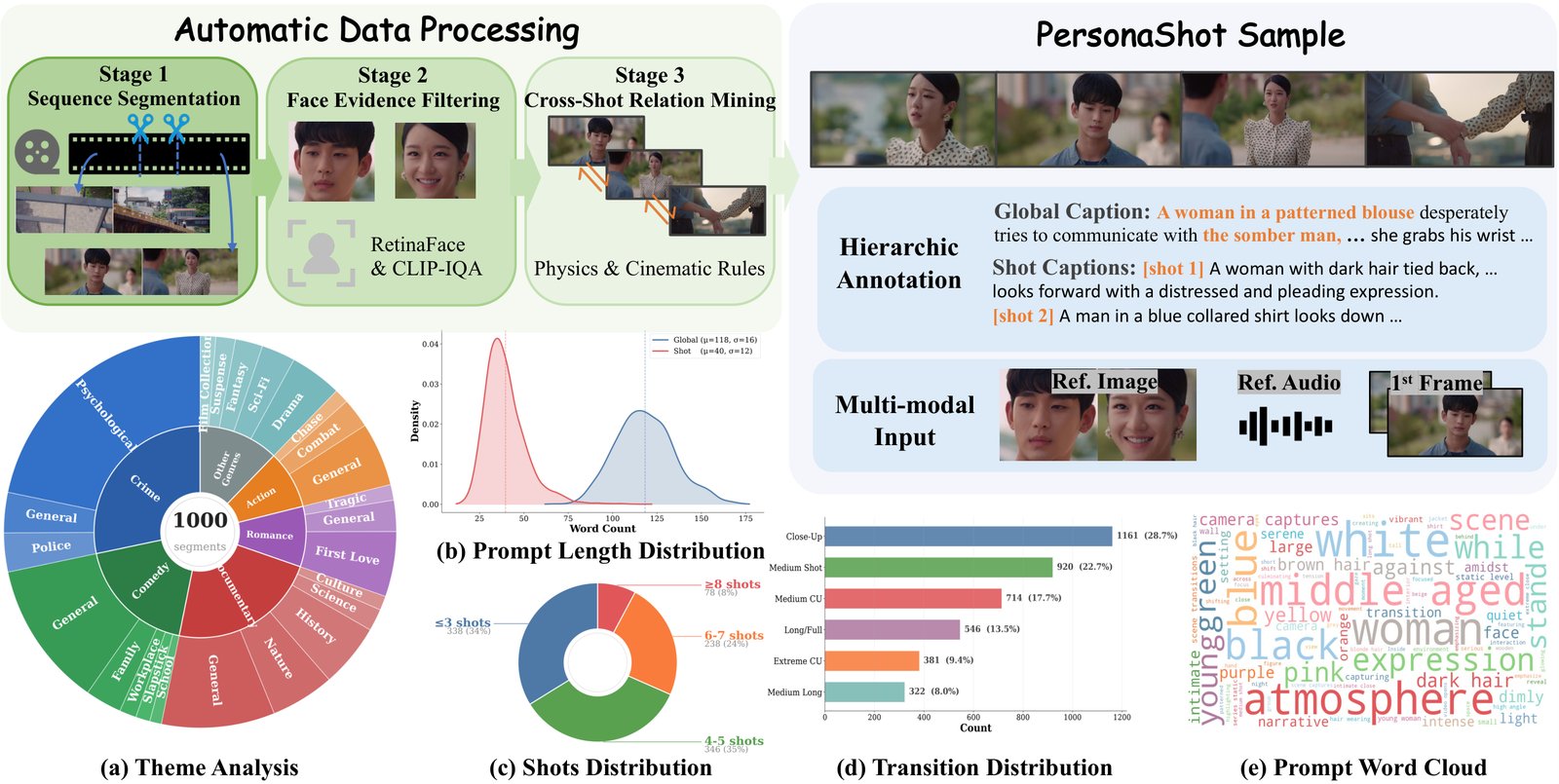
Stage 1: Sequence Segmentation & Character Continuity (TransNetV2, 2–15 shots/segment). Stage 2: Face Visibility & Quality (RetinaFace + CLIP-IQA). Stage 3: Cross-Shot Relation Selection (Qwen-based multimodal reasoning).
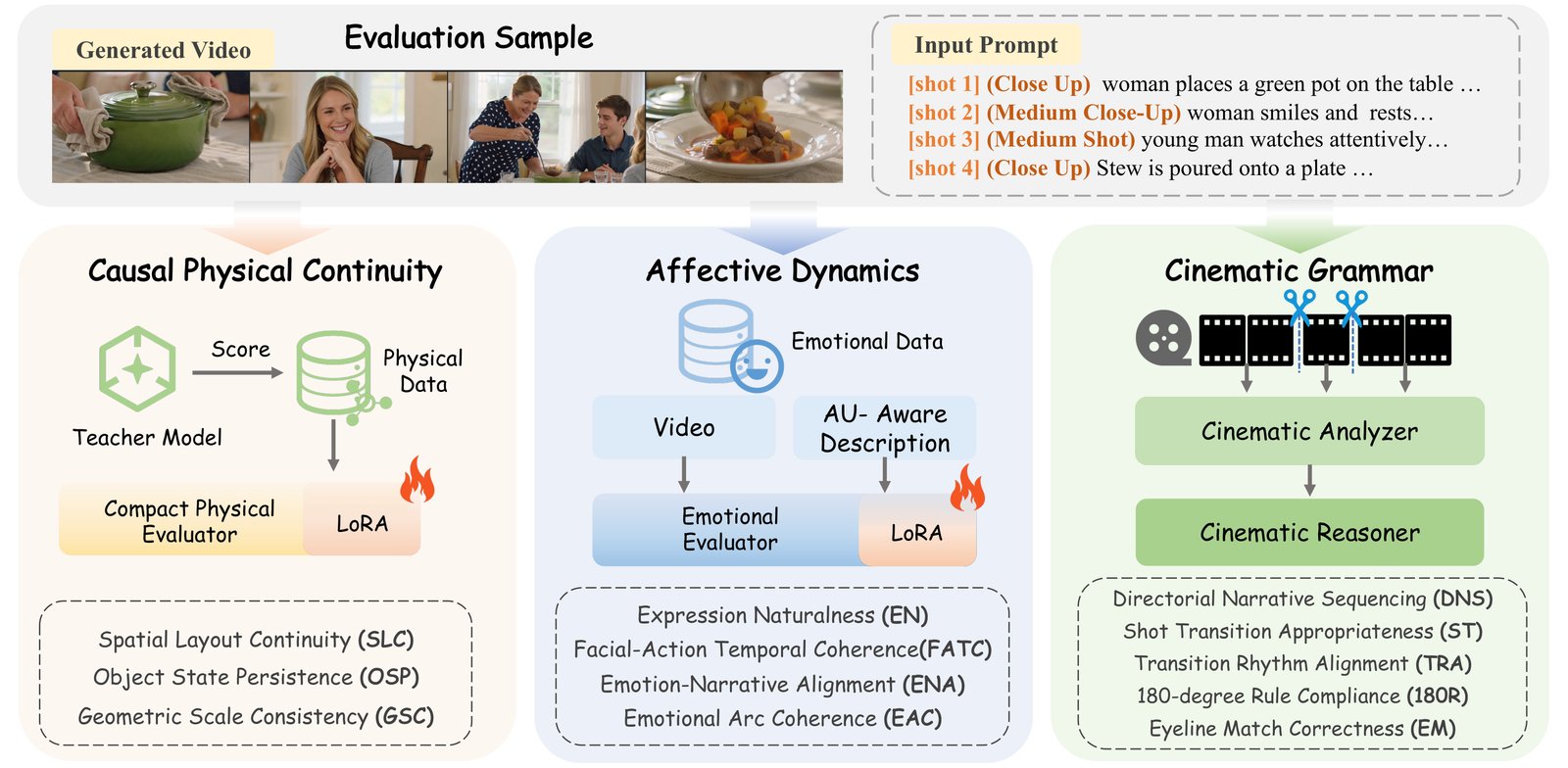
PersonaShot extends conventional quality assessment with three specialist dimensions. Lightweight evaluators (Qwen3.5-4B + LoRA) are distilled from Qwen3.5-397B via criterion-specific evidence.
Physical Continuity: Teacher-guided distillation with strict input isolation — annotations used during training but excluded at inference.
Affective Dynamics: Frame-level Action Unit signals from OpenFace enable AU-aware evaluation based on the Facial Action Coding System (FACS).
Cinematic Grammar: Two-stage pipeline: CineCap extracts professional film-language descriptions, then a reasoner evaluates via TransNetV2 shot boundaries.
Click any column header to sort. Bold = best, underlined = second best.
| Method | Aggregate | Visual Quality and Consistency | Causal Physical Continuity | Affective Dynamics | Cinematic Grammar | |||||||||||
|---|---|---|---|---|---|---|---|---|---|---|---|---|---|---|---|---|
| Method | Aggr. | VF | TVA | ID | SS | SLC | OSP | GSC | EN | FATC | ENA | EAC | ST | TRA | 180R | EM |
bold best · underline second. VF=Visual Fidelity, TVA=Text-Video Alignment, ID=Identity, SS=Scene/Style, SLC=Spatial Layout, OSP=Object State Persistence, GSC=Geometric Scale, EN=Expression Naturalness, FATC=Facial-Action Temporal Coherence, ENA=Emotion-Narrative Alignment, EAC=Emotional Arc, ST=Shot Transition, TRA=Transition Rhythm, 180R=180° Rule, EM=Eyeline Match.
ShotStream achieves highest visual fidelity (.994 VF) yet ranks 7th overall (.601) due to weak affective and cinematic performance.
Seedance leads overall (.793). Global-prompt systems remain competitive in cinematic grammar and identity.
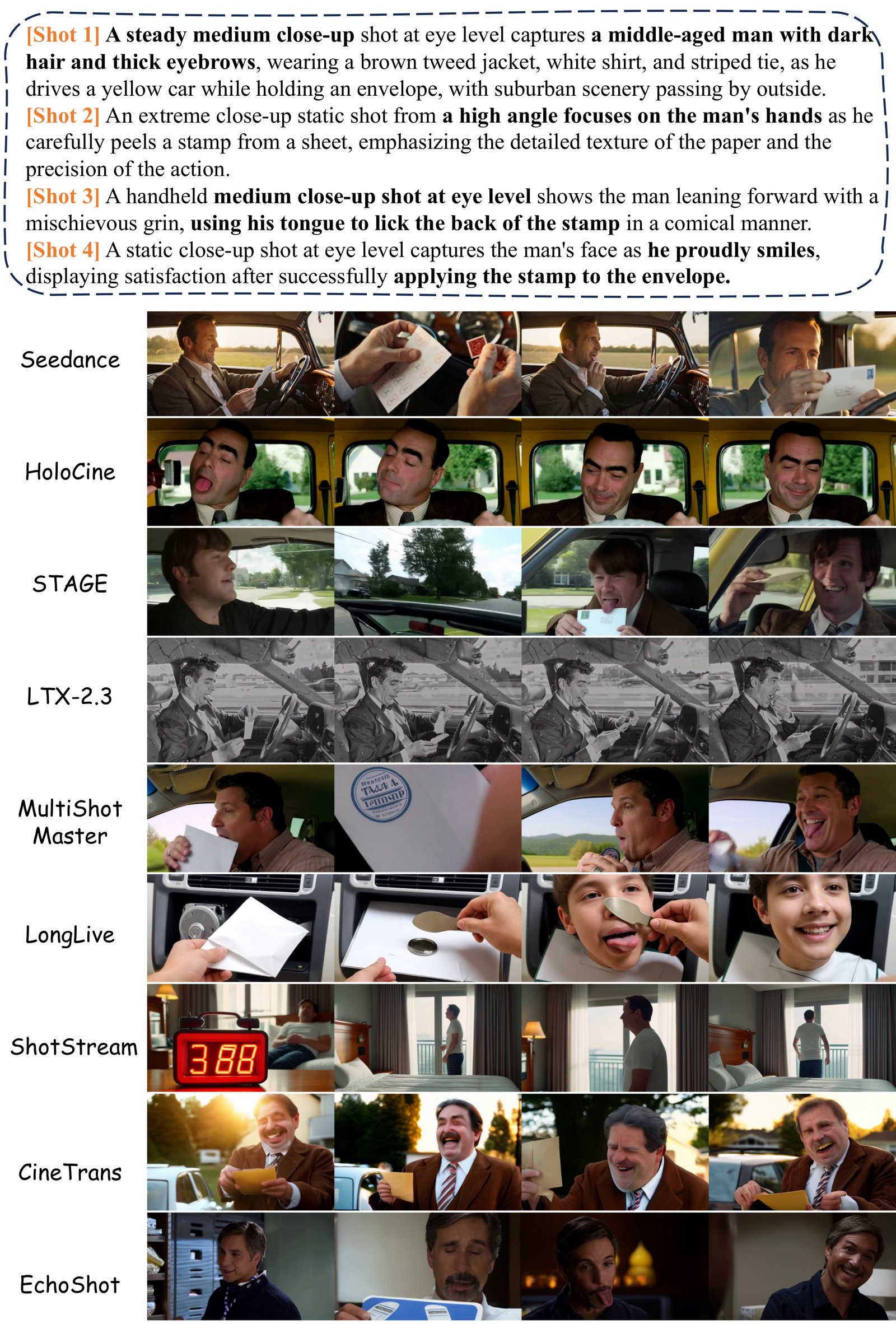
Models struggle with object-state resets, unstable facial dynamics, and weak emotional trajectories across cuts.
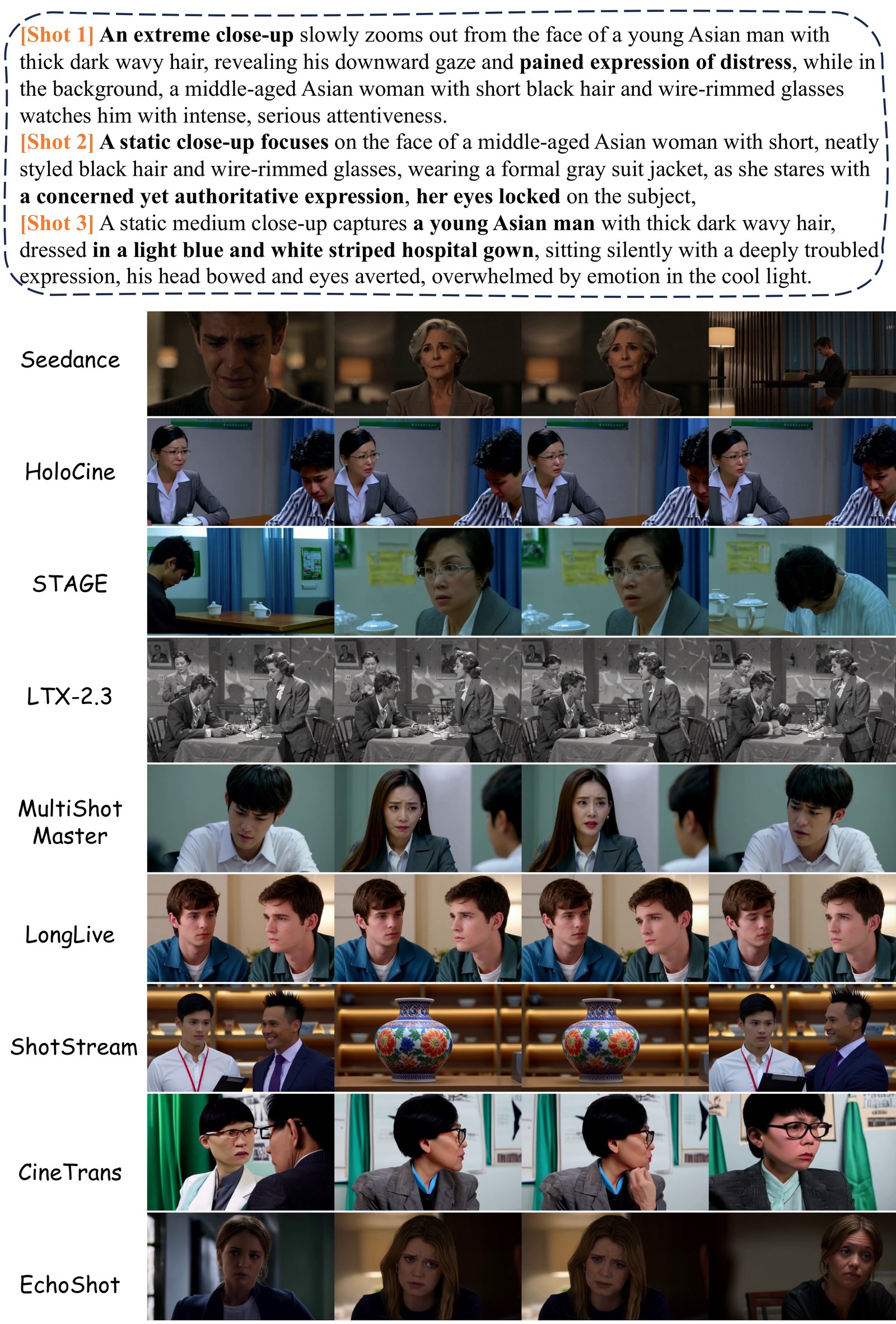
Most systems fail at transition appropriateness, 180° rule compliance, and eyeline matching.
Seedance (0.865 DNS) vs. open-source LTX-2.3 (0.624) and VGoT (0.535) — long-form narrative planning remains a bottleneck.
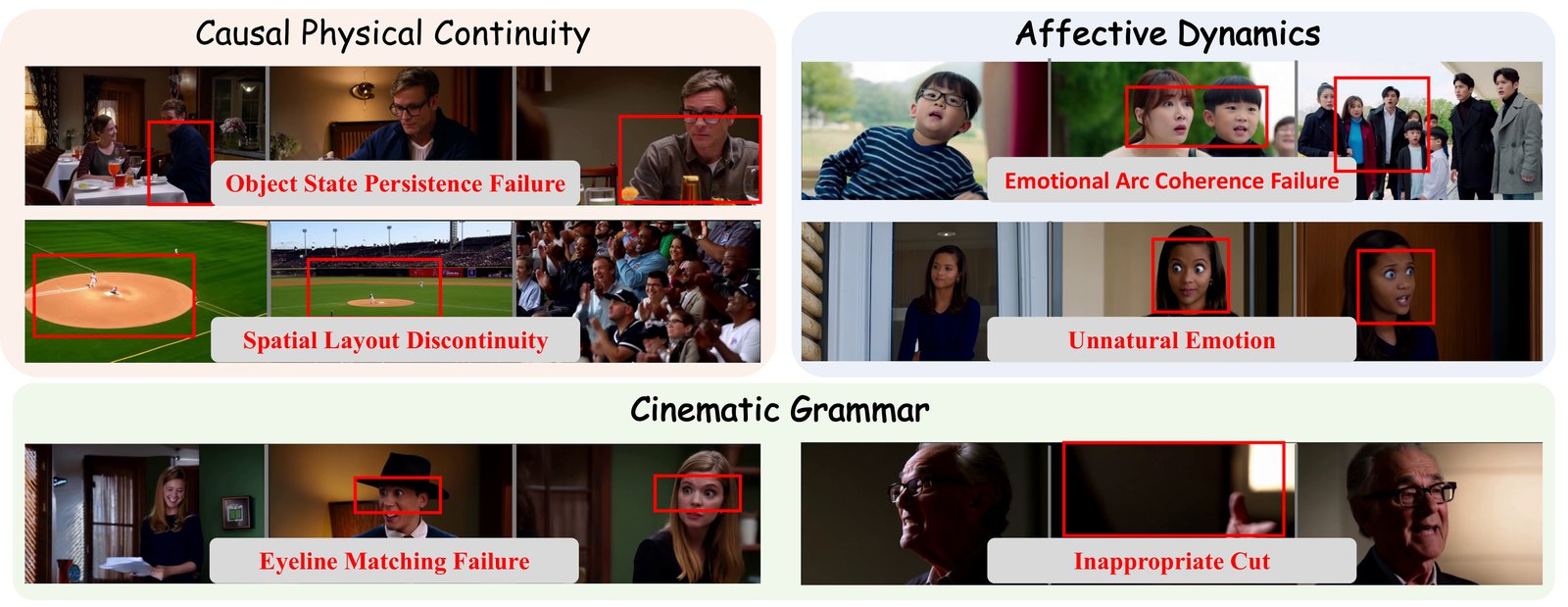
Representative failures across three dimensions: object state resets, emotion inconsistencies, eyeline mismatches, and inappropriate transitions. Many failures are visually plausible per-shot but emerge across temporal and relational evaluation.
Setup: 10 domain experts, 25 multi-shot sequences, 4 annotators per sequence. Krippendorff’s α = 0.76. All correlations p < 0.01.
| Dim. | Criterion | Spearman ρ ↑ | Pair Acc. ↑ |
|---|---|---|---|
| Physical | Spatial Layout (SLC) | 0.68 | 71.4% |
| Object State (OSP) | 0.74 | 76.0% | |
| Geometric Scale (GSC) | 0.66 | 69.8% | |
| Affective | Expression Naturalness (EN) | 0.70 | 71.8% |
| Action Coherence (FATC) | 0.68 | 64.8% | |
| Narrative Alignment (ENA) | 0.71 | 72.5% | |
| Arc Coherence (EAC) | 0.67 | 68.2% | |
| Cinematic | Narrative Sequencing (DNS) | 0.74 | 74.0% |
| Shot Transition (ST) | 0.72 | 73.1% | |
| Rhythm Alignment (TRA) | 0.69 | 70.5% | |
| 180° Rule (180R) | 0.71 | 71.9% | |
| Eyeline Match (EM) | 0.65 | 67.2% |
All 12 specialist criteria evaluated against expert MOS. DNS (ρ=0.74) and OSP (ρ=0.74) show strongest human alignment.
PersonaShot is the first person-centric benchmark for narrative continuity in multi-shot video generation. Through 16 metrics and human-aligned specialist evaluators, it reveals that current generators remain limited in preserving persistent character states, modeling emotional evolution, and following cinematic conventions across shots. We hope PersonaShot serves as both a rigorous testbed and a catalyst for next-generation video foundation models with authentic storytelling capabilities.
@misc{personashot2026,
  title     = {PersonaShot: Benchmarking Person-Centric Narrative Continuity in Multi-Shot Video Generation},
  author    = {Wang, Yuji and Chen, Yuheng and Hu, Teng and Yi, Ran and Hong, Yijia and Feng, Han and Cao, Weijian and Wang, Chengjie and Ma, Lizhuang and Zhang, Jiangning},
  year      = {2026},
  eprint    = {arXiv:XXXX.XXXXX},
  archivePrefix = {arXiv},
  primaryClass = {cs.CV}
}